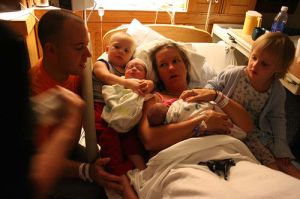
Choosing a Birth Attendant

Most people see pregnancy as a time to prepare for the baby.  I see early pregnancy as a time to figure out what you want before you even go to your first appointment.  A lot of women don’t even think about the actual birth until a few months or weeks before the baby is born!  It can be difficult to make a change that late in the game.  You should choose the provider who has the same philosophy as you instead of hoping to change them by the end of the pregnancy.

Tips for choosing a birth attendant

  • Think about your core birthing philosophy.  Do you feel that birth is a natural physiological process?  If so, a midwife is your best bet.  Do you have physical issues that dictate that there could be a potential problem?  Do you see birth as dangerous with lots of opportunities for things to go wrong?  Then an OB might be your preferred provider.
  • Visit The Birth Survey, a consumer reporting site dedicated to birth.  Go to rate your OB, midwife, and place of birth.  As of now the site is just up and running and they should have formulated the results by Fall of 08
  • Get recomendations from people who share your birthing point of view, visit online forums (like mothering.com) and ask questions.
  • Interview your potential care provider.  Remember, they are working for you, not the other way around.  Related posts:  Interviewing your OB, Interviewing your Midwife, and Interviewing your Place of Birth
  • Create a birth plan well before your second or third trimester.  Going to your provider interview with a birth plan or at least an idea of what you want can help you ask the right questions.  Just make sure to not be negative or badger the doctor!
  • How much one-on-one, hands-on support do you want during pregnancy? Midwives generally treat the whole woman:  mentally, physically, socially, psychologically, spiritually.  Prenatal appointments generally last about an hour and they are usually there for the majority of labor and birth.  OBs on the other hand are primarily surgical specialists who have a prenatal appointment time of about five minutes and generally just come in at the end to catch the baby.
  • How much involvement do you want in your pregnancy and birth? Many times in midwifery practices the mom gets to do her own urine dip and weigh herself at her appointments.  The midwife tries to explain things to her and tries to get her to interact during her visits.  An OB visit is more in-and-out with the nurses doing everything behind the scenes.
  • Where do you want to give birth? Some women just go to an OB because they think they’re supposed to and then realize late in pregnancy that they want a home birth!  Where you give birth automatically dictates who will be there.  For example in Colorado at this time, OBs work in the hospital, only Certified Nurse Midwives (CNM) can work at a birth center, and Certified Professional Midwives (CPM) and CNMs can do home births.  Most CNMs (90-95%) work with doctors in the hospital.
  • Do you want to have a waterbirth? Some hospitals allow it, some do not.  If you have to give birth in a hospital and want to fight a policy that does not allow waterbirth, having a provider who supports it can go a long way.  Yes, it is possible to change hospital policy!  In Gentle Birth Choices Barbara Harper talks about how to do this.
  • Choose someone you’re comfortable with. If you’re not comfortable with your provider there is no way you can let your body open up and relax enough to have a baby.
  • If a provider or place (like home or birthing center) is out of your insurance network, talk to your insurance provider.  Also, often times a home birth or birthing center is cheaper even though you have to pay in full.  For example, in Colorado a typical, no-intervention birth in a hospital usually costs around $12,000-13,000.  In an insurance plan where you pay 10% of hospital and doctor’s costs you’re looking at a few thousand dollars.  A home birth or birth center birth usually costs around that if you’re paying in full.
  • Do you feel more comfortable with a male or female doctor?  Remember that just because a doctor is female doesn’t mean she believes in the same birthing philosophy as you do.


Interviewing Your Midwife

Know your Midwife

It is so important to know what you’re getting into before you’re in labor!  Interview any OBs, midwives, hospitals, and birth centers you are considering and make the best decision for you.  Also, a great new website, The Birth Survey, provides consumer reporting for doctors, midwives, and hospitals (at this point you can take the survey, but the results are said to be formulated by Fall 2008).

Here are some questions to ask your Midwife to make sure you find one who is on the same page with your birthing beliefs.  These are taken from Gentle Birth Choices, written by Barbara Harper, 2005, p. 249 (a great book, also in my library).

  1. What is your education and training as a midwife?
    It is good to discern if you are hiring a certified nurse-midwife (CNM), a certified professional midwife (CPM), or a direct-entry midwife.  Find out what their training or midwifery school was like.  The three groups represent vast differences in educational experience but not necessarily in the way they practice.
  2. What kind of testing or licensing procedure did you go through to become a midwife?
  3. How many years have you been practicing?
    Do you want to trust a midwife who is just starting out in independent practice or do you continue your search for a more experienced midwife?  Find this out right away.
  4. What is your general philosophy about pregnancy and birth?
    Midwives in general hold the philosophy that normal birth is not a medical event and needs to be respected for the creative process that it is.  I would be surprised if you found a midwife who viewed birth as a potential emergency to be prepared for.
  5. Are you a mother yourself?  How old are your children now?
    If you are choosing a midwife with young children, how will she be able to attend your birth if there are family needs?  Are you open to her bringing her young children and perhaps nursing child with her to your birth?  Ask her to share her birth stories with you.  Many women become midwives after a not-so-wonderful birth experience.  Find out about your midwife’s births.  Some argue that midwives who have never given birth cannot be as good as those who have had children.  I don’t agree with this assumption; I know some wonderful, talented, caring midwives who have not had the opportunity to give birth.
  6. Do you work alone or with a partner or assistant?  If you work with someone, what is his or her experience?
    It is important to meet all the people who will have any responsibility concerning your prenatal care, labor, or birth.  Some midwives take on apprentices or students.  Find this out in the beginning.
  7. How many births have you attended as the primary caregiver?
    How long has your midwife been in independent practice?  Has she always worked with an experienced partner?  You may ask for references from former clients.  Some midwives provide a chance for past clients and future clients to meet each other at informal classes or support groups.
  8. Do you attend births in a birth center or hospital?
    Perhaps this midwife has hospital privileges or attends births at home or in a birth center.
  9. How many births do you typically attend each month?
    For a home-birth practice, the most births that one midwife with one assistant can possibly attend is six to eight per month.  If she tries to attend more, there could be two women in labor at the same time, leaving one with no coverage.  Midwives in birth centers can handle many more births per month because they can attend more than one laboring woman at a time.
  10. Who takes over for you if you go on vacation or get sick?
    A very important consideration is who will take over the midwife’s practice if she is unable to continue or needs to leave for a certain period of time.  Make these plans with your midwife early on in your pregnancy.  Know that if you will be covered if anything happens to your midwife.
  11. Do you have guidelines or restrictions about who can give birth at home?
  12. Are these your policies or those that the state licensing requires?
    A midwife should have the same screening criteria as a doctor screening for risk factors.  Depending on licensing status, some midwives must refer to a physician for cases of breech or twins or even VBAC.  Other states have less restrictive or no guidelines.  This must be discussed.

  13. Do you require that I see a physician during my pregnancy even if everything is all right?
    A visit to a backup physician is usually in order just so you can meet and he or she can establish a chart on you.  If your midwife does not have an active relationship with a backup physician, it may be your responsibility to obtain a doctor and see him or her.
  14. What are your fees and what do they include?
    Just as with a doctor, most midwives’ fees cover all prenatal care, birth, newborn assessment, home care, and follow-up for six weeks.  Any lab tests, diagnostic tests, or extra doctor’s visits are not included.  Also not included are the costs of a hospital transfer, including ambulance, hospital, and doctor’s fees.
  15. Can you submit your charges to my insurance company?
    Many CPM and CNM services are covered by health insurance plans or state-funded Medicaid programs.
  16. What payment arrangements do you make?
    Most midwives will make an affordable arrangement to take payments throughout pregnancy.  Many even have payment forms and billing systems on their computers.  Payment of services in full is usually required before the birth.  Be considerate about the midwife’s bill and make clear and early arrangements for payment.
  17. How often will I see you?
    Visits are scheduled once a month until the seventh month, every two weeks until thirty-six weeks, and once a week after that.  Extra appointments can be scheduled at any time between regular visits.
  18. What are your guidelines concerning weight gain, nutrition, and exercise?
    Nutritional status will be monitored throughout pregnancy.  Most midwives focus on the importance of a healthy balanced diet and work with women to get the most out of what they eat.  Many midwives have special education in the use of herbs, food supplements, and homeopathy for pregnancy.
  19. Do you require that I take a childbirth education class?  Do you teach a childbirth preparation class?
    Midwives will often teach their own preparation classes.  Some midwives feel that they give so much individualized attention that couples do not need extra classes to prepare for birth.
  20. If I am planning a home birth, do you visit my home before I go into labor?
    Midwives generally make at least one home visit before they come to the house for labor.  They assure that the home is adequate and clean, and they help plan any necessary details with the couples, such as where the birth pool should go.
  21. When should I call you after my labor begins?
    Each midwife sets her own protocols about when and the reasons why to call after labor begins.  Generally midwives want to know as soon as contractions begin so they can plan their day (or night).  Some midwives will have apprentices who come right away, others arrive when they are needed.  Most encourage women to enjoy the early stages of labor and to get plenty of rest and eat if they are hungry.
  22. How do you handle emergencies?
    Ask very carefully just what kind of emergencies she is prepared to deal with and has dealt with in different situations.  A very experienced midwife may have different answers from someone just graduating from midwifery school, but their protocols should be very similar.
  23. In what situations would I need to go to the hospital?
    Find out exactly why you might be transported.  Transports can sometimes be an emergency, but more than likely they are for women who have been laboring for more than a day and become exhausted.  Find out what your midwife’s transport rate is and evaluate it.  Most home birth midwives and birth centers have a rate of less than fifteen percent.
  24. Would you stay with me in the hospital?
    Most midwives can accompany their clients into the hospital and stay with them, but in some states where midwifery is still illegal, the midwife cannot come into the hospital and admit that she has been attending a home birth.  Find out if your midwife has a good working relationship with a local hospital.
  25. What is your experience with water for labor and birth?
    Midwives traditionally have used water for pain relief during labor.  Many are now advocating its use by all of their clients.   It is difficult to find a midwife today who doesn’t use water in labor or for birth.
  26. Can I give birth in water?
    Ask if your midwife has access to a birth pool for her clients or if she knows where you can rent or purchase one.  Find out if she truly supports the option of waterbirth.  I have talked with many women who have said that their midwives talked about waterbirth prenatally and even encouraged water labor, but then asked the mother to get out of the birth pool at the last minute.
  27. How ‘hands off’ are you during a birth?
    Is your midwife is willing to “allow” the family to conduct the birth under her supervision?  Ask if she is willing to give you complete control.  Will she encourage or instruct you and your partner when and how to catch the baby?  Will she leave you alone in another room if that is what you want?  How involved can your children be in the labor and birth?
  28. What is your experience with breech births?  How many have you attended?
    Breech may be beyond the scope of practice for some licensed midwives.  Others handle it just like any other birth and specialize in breeches, especially in water.
  29. What in your experience with twins?  How many have you attended?
    Twins may also be beyond the scope of practice.  Find this out before you make further plans. (It is also illegal to have twins anywhere but in a hospital in Colorado)
  30. Do you cut episiotomies and suture perineal tears?
    Home-birth can birth-center midwives usually have an episiotomy rate of close to zero, but tears do sometimes happen during birth.  Unless your midwife sutures well, you may need to travel to a hospital if you need stitches.  This might influence your choice of practitioners.
  31. What is your experience with a VBAC?
  32. Will you attended a VBAC at home? in the hospital?
    Many midwives cannot legally attend a first-time VBAC at home because of licensing restrictions.  Some are willing to look the other way in order to give the woman a chance.  This is a very serious consideration that requires much discussion with your midwife.
  33. Have you ever had to resuscitate a baby?
    Assess the resuscitation skills of the midwife.  Midwifery organizations and nursing schools teach courses in neonatal resuscitations, and your midwife should have a current certificate.  As to see it.  Ask if her resuscitation course focused on the latest information about the consciousness of newborns.
  34. What kind of equipment do you bring to a birth?
    Find out what kind of drugs, oxygen, resuscitation equipment, intravenous (IV) equipment, and other emergency equipment your midwife keep sin her bags.
  35. Do you examine the baby after birth?
    Midwives perform a normal newborn exam on the baby usually an hour or two after the baby has been born and breast-fed.  Assess from the midwife what her routines are for newborn exams and what she uses for eye drops and vitamin K.  She may use alternatives such as oral vitamin K.
  36. Will you help me with breast-feeding?
    Midwives should be on call twenty-four hours a day, seven days a week, for all problems after birth, especially breast-feeding.  Many even have special classes or private sessions to evaluate breastfeeding readiness and answer any questions.  Some have great relationships with lactation conselors or consultants for more difficult problems.  Babies born without medications usually have an easier time breast-feeding, but that doesn’t mean every mother automatically has an easy time.
  37. How often do you come to see me after I give birth?
    Home-birth midwives generally come back for follow-up visits after twenty-four hours, two days, five days, and ten days.
  38. Do you provide or know of anyone who will help new mothers after birth?
    Some home-birth services provide a postpartum doula or can recommend one for help after the baby’s birth.  There is generally an extra charge that is well worth every penny.
  39. Do you have a pediatrician you work with or recommend?
    Some naturopathic doctors who attend home births automatically become the pediatrician.  Midwives often have collaborative relationships with pediatricians who support home birth and possibly delayed immunizations or not immunizing at all.  Interview pediatricians the same way you would your provider.
  40. How do you feel about circumcision?
    I don’t know of very many midwives who will present both viewpoints about circumcision unless their clients are Jewish or Muslim.  If there is a religious consideration, the thoughtful midwife will support her clients’ decision.

Interviewing Your Place of Birth

It is so important to know what you’re getting into before you’re in labor!  Interview any OBs, midwives, hospitals, and birth centers you are considering and make the best decision for you.  Also, a great new website, The Birth Survey, provides consumer reporting for doctors, midwives, and hospitals (at this point you can take the survey, but the results are said to be formulated by Fall 2008).

Here are some questions to ask your hospital or birth center to make sure you find a place that is on the same page with your birthing beliefs.  These are taken from Gentle Birth Choices, written by Barbara Harper, 2005, p. 246 (a great book, also in my library).

  1. Does the hospital [/birth center] encourage women to follow written birth plans?
    This is a question for a hospital [/birth center] but it may also be asked of the physician.
  2. Could you tell me how a routine vaginal birth is handled here?
  3. When do I need to check into the hospital [/birth center]?
    The longer you stay at home in early labor, the less possibility there will be for interventions.
  4. Can I labor, give birth, and stay with my baby in the same room?
    The concept of labor, delivery, recovery, and postpartum (LDRP) in the same room has been promoted for the last ten years.  If your prospective hospital is one that still transfers women into a delivery room, request that they make an exception in your case.  (There is nothing worse than being moved right before pushing!) Also be aware of the “cosmetic cover-up” discussed in chapter 8.  Not all LDRP rooms are alike, and not all allow women to do what they want.
  5. Do you routinely require an IV?
  6. Do you routinely require electronic fetal monitoring during labor?
  7. How often does someone do a vaginal exam to assess progress?
  8. What mechanism is in place so that I can refuse routine interventions like vaginal exams?
  9. How soon after my labor begins will you (or the doctor on call) come to see me?
  10. Whill you stay with me during labor?
  11. Can my partner stay with me the entire time?
  12. Can the rest of my family members, including my children or my mother and father, be present during labor and birth?
  13. Does the hospital have showers or baths in each room?
  14. Can I eat and drink during my labor?
  15. Do you encourage women to walk, squat, or be on their hands and knees during labor?
    Understanding the philosophy behind why you need to remain active during labor encourages women to move.  Lying still on a bed during labor is probably the hardest thing for women to cope with.
  16. Can I birth the baby in the position of my choice?
    Hospital beds often break apart at the foot to “allow” a woman to semi-squat.  What some women have found easier is to simply put the mattress on the floor or be supported by their partners while they squat on the floor.  Assess early on if those alternatives are acceptable to your doctor and the hospital.
  17. Can I use a warm bath for pain relief during my labor, even if my water has broken?
    There is absolutely no reason to restrict the bath even with ruptured membranes.  One woman at Santa Monica Hospital was promised that she would be able to use the brand-new baths that had been installed for labor.  What her doctor did not tell her was his list of restrictions:  A woman could not take a bath if her water had not broken and the head had not engaged into the pelvis (for fear of a cord prolapse), and she could not enter the water after her water had broken (for fear of infection).  She never once used the new baths and ended up with an epidural and her baby experienced the application of low-forceps.
  18. Can I stay in the water to birth my baby?

    Find out right away what position your doctor takes on waterbirth.  It might be your opportunity to educate him or her.
  19. What kind of pain medication do you routinely use?
  20. What kinds of nonpharmacological pain management techniques do you recommend?
  21. If I want an epidural, what are your guidelines?
    Some doctors offer a “walking epidural” which is a different kind of epidural.  Question your doctor carefully about the kids of medication used and the guidelines with which they are administered.
  22. Do you do episiotomies?  Why?  In what percentage of births?
    Does your doctor think that episiotomies are necessary?  Is he or she willing to allow you to try other techniques?  If a doctor cuts more than 10 percent of birthing clients, look for a new doctor.
  23. Do you ever use vacuum extractor?  In what percentage of births?
    Vacuum extractors were developed to take the place of low forceps.  A large suction cup (usually made of hard plastic and sometimes silicone) is placed on the baby’s scalp.  The cup is attached to a tube that is attached to a vacuum.  When a suction on te baby’s head has been achieved, constant suction will quite literally pull the baby out within ten to twenty minutes.  There are some risks with extraction, such as perineal lacerations, hematomas on the baby’s scalp, and pain for both mother and baby.  It requires a fully dilated cervix, a baby with at least some part of the scalp visible in the birth canal, and the cooperation of the mother.  Vacuum extraction is preferred over the use of forceps.
  24. Do you ever use forceps?  In what percentage of births?
  25. What is your policy concerning stripping or rupturing membranes?
    Rupturing membranes is often the first intervention that doctors do to “get labor going.”  Ask your doctor if a labor can progress normally and slowly without rupturing the membranes.  Will you be informed of his or her desire to break your water?  Do you have the right to refuse this intervention?  Assess your doctor’s guidelines for ruptured membranes.  How long will he or she allow you to go without starting labor?  What lab tests are required? Some doctors take white blood counts every twenty-four hours and body temperatures every hour and leave a woman alone.  Others want her hospitalized immediately and induce labor with Pitocin.  Studies have shown that women who walk and remain active have fewer cesareans and generally give birth before those who receive Pitocin.
  26. How long will you allow me to labor before starting interventions?
    Does your doctor go by the book in judging length of labor?  What are his or her considerations:  maternal exhaustion, nutritional needs, movement?
  27. How long will you wait to cut the cord and deliver the placenta?
    (Cutting the cord after it stops pulsing allows the baby’s organs to perfuse with much-needed blood, replenishes iron stores, and creates a smoother transition from oxygen from placenta to oxygen from baby’s lungs)
  28. Can my partner cut the cord?
    Is cord cutting viewed as a medical procedure or simply part of the process of birth that the couple has shared?  Are fathers included in this process?
  29. Is it necessary to put antibiotics in the baby’s eyes right away or can we delay that for 24 hours?
    State laws mandate that an antibacterial agent be put into the baby’s eyes to reduce the incidence of blindness from venereal disease that has been passed from the mother to the baby.  The use of silver nitrate has been abandoned by most hospitals.  More common antibiotic agents are now used.  Find out from your doctor what he or she recommends, and ask if you can choose not to use anything at all, especially if your baby is not at risk.
  30. Do you routinely give vitamin K shots to newborns?
    Vitamin K is routinely given to prevent hemorrhagic disease in newborns.  The incidence of intracranial hemmorhage is extremely low.  The administration of vitamin K has also been given to counteract the possibilities of bleeding after circumcision.  There has been an unusually high incidence of childhood ancer linked to vitamin K shots.  Oral vitamin K has not shown any relationship to cancer in children.  Ask your doctor if oral vitamin K may be substituted and if he or she has access to the latest research.
  31. Can I breast-feed immediately after birth?
  32. Can I delay weighing and measuring the baby for at least an hour?
  33. Can the baby stay with me in my room (rooming-in)?
  34. Do you routinely recommend circumcision?
    If your doctor is still suggesting circumcision and does not stress the normalcy of the intact penis, take the opportunity to educate him or her before you find another doctor.
  35. How soon after the birth can we leave the hospital?
    Most doctors recommend a short stay in the hospital.  Some are even willing to discharge after twenty-four hours.  Find out if your doctor is open to discharge after six to twelve hours, especially if you have given birth vaginally and you have adequate help at home.

Interviewing Your OB

Know your Obstetrician

It is so important to know what you’re getting into before you’re in labor!  Interview any OBs, midwives, hospitals, and birth centers you are considering and make the best decision for you.  Also, a great new website, The Birth Survey, provides consumer reporting for doctors, midwives, and hospitals (at this point you can take the survey, but the results are said to be formulated by Fall 2008).

Here are some questions to ask your Obstetrician to make sure you find one who is on the same page with your birthing beliefs.  These are taken from Gentle Birth Choices, written by Barbara Harper, 2005, p. 244 (a great book, also in my library).

  1. What is your general philosophy concerning pregnancy and birth?
    When you interview obstetricians, it is important to assess right away how liberal or traditional they are in their own practice.  Are they open to new ideas or do they practice by the book?
  2. How long have you been practicing?
    Some women may want a doctor who has attended a few thousand births, others may want to work with someone who is just starting out in practice and has fresh energy and openness about all birth situations.
  3. Are you board-certified?  If not, why?
    Each specialty of medicine has its own examining board that certifies doctors by written and oral examination.  Being board-certified states that this doctor holds to a very high set of standards within the obstetric profession; however, this is no assurance of a particular physician’s ability.  Some physicians voluntarily choose not to be certified; others have been denied certification.
  4. Do you have any children and how were they born?
    Having a female obstetrician will not automatically guarantee a lower intervention rate.  Sometimes you will find a compassionate male doctor who actually gave birth at home or in a birth center or who has caught his own children.  They are more likely to understand your requests for freedom of choice.
  5. Do you use midwives in your practice?
    Not all obstetricians will advertise the existence of midwives on their staffs.  If they do work with a midwife, you can request her services.
  6. What are your guidelines for “normal” and “high-risk” pregnancies?
    Screening requirements vary from doctor to doctor.  Some view all women over thirty-five as high risk; others do not see age as a significant factor.  Standard obstetrics today views a woman who has had three children as high risk as well as the woman who is having her first baby.  The set of guidelines that each doctor uses provides him or her with a picture of possible complications.  By concentrating on the person and not the picture, better maternity care can be provided.
  7. What is your regular fee?  What does this fee include?
    Normal prenatal care usually includes all tests performed within the doctor’s office (blood tests for hemoglobin, urinalysis, and blood glucose levels) and delivery at the hospital.  What fees do not cover are extra lab tests or the initial diagnostic work-up.  These fees are paid directly to the laboratory.
  8. What routine tests do you require?
  9. Under what circumstances would you require ultrasound during pregnancy, alpha-fetoprotein (AFP), chorionic villi sampling (CVS), amniocentesis, glucose tolerance test (GTT)?
  10. How often do you do cesarean sections and for what reasons?
    Definitely assess this doctor’s cesarean-section rate and ask for the reasons for them.
    (I would also add, they cannot do anything to you in the hospital without your consent, but having a doctor with a high cesarean rate makes it more likely that he/she will pressure you)
  11. If my baby is breech, can I give birth vaginally?
    By 1990 most medical schools were no longer teaching the procedures for vaginal breech birth.  A breech baby, no matter what position, was classified as an automatic reason for a cesarean.  There have been a number of studies that show that breech births are safer for mother and baby and there are some doctors who will agree to at least a trial of labor and possibly a vaginal birth.
    (Dr. Michael Hall at Swedish Hospital does vaginal breeches when appropriate and he is the only doctor I know of in the Denver area)
  12. Do you encourage women who have had one cesarean section to give birth vaginally?
    Definitely know the position of both your care provider and hospital about vaginal birth after cesarean.  If you have already had a cesarean, this will be the most important determining factor in considering who will be your provider.
  13. Do you have specific recommendations concerning weight gain, diet, and excercise?
    Doctors are less likely today to insist on a restricted weight gain and more likely to recommend a healthy diet and exercise plan.  Keeping active throughout your pregnancy will enhance your ability to labor and give birth and decrease your chances of gestational diabetes.
  14. Do you require or suggest that I take a childbirth class?
    All first-time couples benefit greatly from taking an informative and practical birth preparation class, and doctors are recognizing the value of preparation.  If you encounter a doctor who doesn’t think childbirth classes are important, keep looking.
  15. How often will I see you?
    Visits are usually scheduled once a month until the seventh month, every two weeks until thirty-six weeks, and once a week after that.  Extra appointments can be scheduled at any time between regular visits.  Depending on how busy the practice is, you might only be seeing your doctor for as little as five minutes at each appointment.  If you want longer prenatal visits, look for a new provider, especially a midwife.
  16. Do you return calls personally or ask your nurses to call?”
    If the nurses on staff in the doctor’s office can handle normal questions, it can be pleasant to develop a relationship with them.  But it is good to know how calls and questions are handled before they arise.
  17. If there is more than one doctor in the practice, what is your rotation policy?  How often are you on call?   Will I be seen by each doctor in the practice?  Who will actually be at my birth?  Do I have a choice?  Will the other doctors respect the agreements you make with me?
    It is very important to meet either the other partners in your doctor’s practice or whoever covers the practice when he or she is out of town or unavailable.  If your doctor has a buys practice, it is not reasonable to assume that he or she can attend every birth.  Therefore, interview the other doctors and make sure they share your philosophies and goals and that they understand how you want your birth to be.  Don’t wait until you are in labor to be disappointed.
  18. Where do you have hospital privileges?  Can I choose which hospital if you have privileges at more than one?
    Take a tour of each hospital and choose the one you want to birth in.  Your doctor may not want to travel across town or out of his area.  Hospitals often grant privileges to other doctors in special circumstances.
  19. Do you encourage women to walk, squat, or be on their hands and knees during labor?
    Understanding the philosophy behind why you need to remain active during labor encourages women to move.  Lying still on a bed during labor is probably the hardest thing for women to cope with.
  20. Can I birth the baby in the position of my choice?
    Hospital beds often break apart at the foot to “allow” a woman to semi-squat.  What some women have found easier is to simply put the mattress on the floor or be supported by their partners while they squat on the floor.  Assess early on if those alternatives are acceptable to your doctor and the hospital.
  21. Can I use a warm bath for pain relief during my labor, even if my water has broken?
    There is absolutely no reason to restrict the bath even with ruptured membranes.  One woman at Santa Monica Hospital was promised that she would be able to use the brand-new baths that had been installed for labor.  What her doctor did not tell her was his list of restrictions:  A woman could not take a bath if her water had not broken and the head had not engaged into the pelvis (for fear of a cord prolapse), and she could not enter the water after her water had broken (for fear of infection).  She never once used the new baths and ended up with an epidural and her baby experienced the application of low-forceps.
  22. Can I stay in the water to birth my baby?
    Find out right away what position your doctor takes on waterbirth.  It might be your opportunity to educate him or her.
  23. What kind of pain medication do you routinely use?
  24. What kinds of nonpharmacological pain management techniques do you recommend?
  25. If I want an epidural, what are your guidelines?
    Some doctors offer a “walking epidural” which is a different kind of epidural.  Question your doctor carefully about the kids of medication used and the guidelines with which they are administered.
  26. Do you do episiotomies?  Why?  In what percentage of births?
    Does your doctor think that episiotomies are necessary?  Is he or she willing to allow you to try other techniques?  If a doctor cuts more than 10 percent of birthing clients, look for a new doctor.
  27. Do you ever use vacuum extractor?  In what percentage of births?
    Vacuum extractors were developed to take the place of low forceps.  A large suction cup (usually made of hard plastic and sometimes silicone) is placed on the baby’s scalp.  The cup is attached to a tube that is attached to a vacuum.  When a suction on te baby’s head has been achieved, constant suction will quite literally pull the baby out within ten to twenty minutes.  There are some risks with extraction, such as perineal lacerations, hematomas on the baby’s scalp, and pain for both mother and baby.  It requires a fully dilated cervix, a baby with at least some part of the scalp visible in the birth canal, and the cooperation of the mother.  Vacuum extraction is preferred over the use of forceps.
  28. Do you ever use forceps?  In what percentage of births?
  29. What is your policy concerning stripping or rupturing membranes?
    Rupturing membranes is often the first intervention that doctors do to “get labor going.”  Ask your doctor if a labor can progress normally and slowly without rupturing the membranes.  Will you be informed of his or her desire to break your water?  Do you have the right to refuse this intervention?  Assess your doctor’s guidelines for ruptured membranes.  How long will he or she allow you to go without starting labor?  What lab tests are required? Some doctors take white blood counts every twenty-four hours and body temperatures every hour and leave a woman alone.  Others want her hospitalized immediately and induce labor with Pitocin.  Studies have shown that women who walk and remain active have fewer cesareans and generally give birth before those who receive Pitocin.
  30. How long will you allow me to labor before starting interventions?
    Does your doctor go by the book in judging length of labor?  What are his or her considerations:  maternal exhaustion, nutritional needs, movement?

Massage

Massage can be a great way to help a laboring woman cope with labor.  During contractions a woman may tense up her muscles leading to the fear-tension-pain cycle which can easily spiral out of control.  Massage helps a woman relax as well as helps to keep her mind off the painful sensations.  Massage can also release endorphins which help the mom cope with pain.  Here are some types of massage that some women find helpful.  Don’t be discouraged if in labor she rejects these!  What might feel good one moment might feel horrible the next!

Tip:  Don’t try a technique after a contraction has already started as it can be distracting.  Start in between contractions and continue through if the mother wants you to.

The tips include:

Effleurage

Description:  Light touch applied over a large are of the body, like the back or the arm

  • Broad effleurage – Use your whole palm to massage a wide area.  Lotion or oil is good at maintaining a smooth movement
  • Feathering – Use just your fingertips to create a more delicate sensation

Here is a video on effleurage

Return to the list!

Kneading

Description:  Wrap your hands around the arms, back, etc. and spread the muscles in opposite directions, like kneading dough

  • This can be good to get a mother to relax in between contractions but may be too intense during contractions
  • Watch your partners body for signs of tension and then try and massage those parts
  • Shoulders, arms, and legs can be helpful but make sure to do it strongly enough so that it doesn’t tickle, but gently enough to where it doesn’t hurt

Return to the list!

Pressure

Description:  Pointed pressure applied to the body using a firm point like your fingertips.  Steady pressure that increases gradually.

  • Good places to do this include down the spine and shoulder blades
  • Firm pressure in a circular motion at just the right spot may relieve tension

Return to the list!

Stroking

Description:  Using light-touch methods to release endorphins

  • Use smooth movements and try not to tickle
  • Cover wide areas
  • Don’t stroke in two directions, start and end on the same point
  • Stroke down long parts of the body, ie the back, arms, legs

Return to the list!

Midwives Model of Care

The Midwives Model of Care reflect the idea that pregnancy, birth, and postpartum are a natural, normal phase in a woman’s life and should not be treated like a catastrophe waiting to happen.  They protect the birthing space from elements that might make a mother self-conscious or alarmed.  They also discourage medical management of labor and instead let the process work while lovingly guiding the laboring woman emotionally, physically, and spiritually.

Elements of the Midwives Model of Care

The following statement of purpose was developed by the Midwives Association of North America (MANA), the North American Registry of Midwives (NARM), the Midwivery Education Accredidation Council (MEAC), and the Citizens for Midwifery (CFM).

The Midwives Model of Care includes:

  • Monitoring the physical, psychological, and social well-being of the mother throughout the childbearing cycle
  • Providing the mother with individualized education, counseling, and prenatal care, continuous hands-on assistance during labor and delivery, and postpartum support
  • Minimizing technological interventions
  • Identifying and referring women who require obstetrical attention

The application of this woman-centered model of care has been proven to reduce the incidence of birth injury, trauma, and cesarean section.

You can download a brochure of this information here

Identifying Labor

How do you know you’re in true labor if you’ve never had a baby before?  The last few days of pregnancy can make for some exciting, nerve-wracking times.  Here are clues that you could be in true labor.

Contact your care provider if these signs happen prior to 37 weeks as you may be in preterm labor.

Click here for a video on preterm labor

In true labor

  1. Bloody show or loss of the mucous plug: This can be spotting or pink-tinged mucous (yes, it basically looks like bloody snot) on a tissue when you go to the bathroom.  It happens when the cervix begins to dilate and the mucous plug that protected the baby from infection drops out.
  2. “Lightening”: This is when the baby drops further into your pelvis.  It’s called “lightening” because you can breathe again due to the baby putting less pressure on your lungs.  You may, however, feel much more pressure on your pelvis and bladder.  Oh well, you can’t have it all!  This can happen a few weeks before labor with a first time mom, and can happen much later for a second time mom.
  3. Rupture of Membranes: This is a sure-fire way to tell if you’re in labor.  This is when the bag of amniotic fluid breaks.  If it’s a high tear it may only trickle and may gush if you were, say, on the toilet or throwing up.  If it’s a lower tear it would be like a rush of water.  If it’s just a trickle, it may be urine (since by now you may have realized your bladder doesn’t function quite as well when you’re pregnant).  If you’re unsure you can go to your care provider and they can test with a pH strip to see if it was truly amniotic fluid.
  4. Effacement and Dilation: When your cervix thins out, becomes soft, and dilates.  If this accompanies regular contractions you’re in labor.
  5. Patterned, Consistent Contractions: In real labor, contractions get longer, stronger, and closer together as time goes on.  They also don’t stop if you drink a lot of water, change your position, or change your activity level.  Sometimes Braxton-Hicks (practice) contractions are regular, but if they go away if you change position they are not true contractions.  Braxton-Hicks contractions may be felt as early as mid-pregnancy.
  6. Nesting: Sometimes moms have a burst of energy right before the baby is born.  You may want to clean the whole house or start a project.  Do what you feel comfortable to do, but still conserve your energy for the marathon that is birth.  Also, if you don’t paint your kitchen, your new baby will not mind.
  7. Feeling Overwhelmed: I added this one because it’s one I felt personally.  The day before I went into labor with my second daughter I had a total hormonal breakdown.  I just felt completely overwhelmed and like I wanted to hole up in my home and conserve.

Video – Trailer of Orgasmic Birth

Here is a movie I think every woman should see.  Please don’t be turned off by the name, it’s not all unrealistic portrayals of women having wild orgasms in labor.  What it does is show you what birth can be like if you open yourself to your birthing body and give birth in a quiet, undisturbed way.  This movie is incredibly beautiful and powerful.